Prof. Dr. Juan José Castellón

26MM_X02
Kelly Yu, Amber Peng, Yang Wang, Andrew Trinidad
PHYSICAL MODEL


DIGITAL MODEL


PROCESS


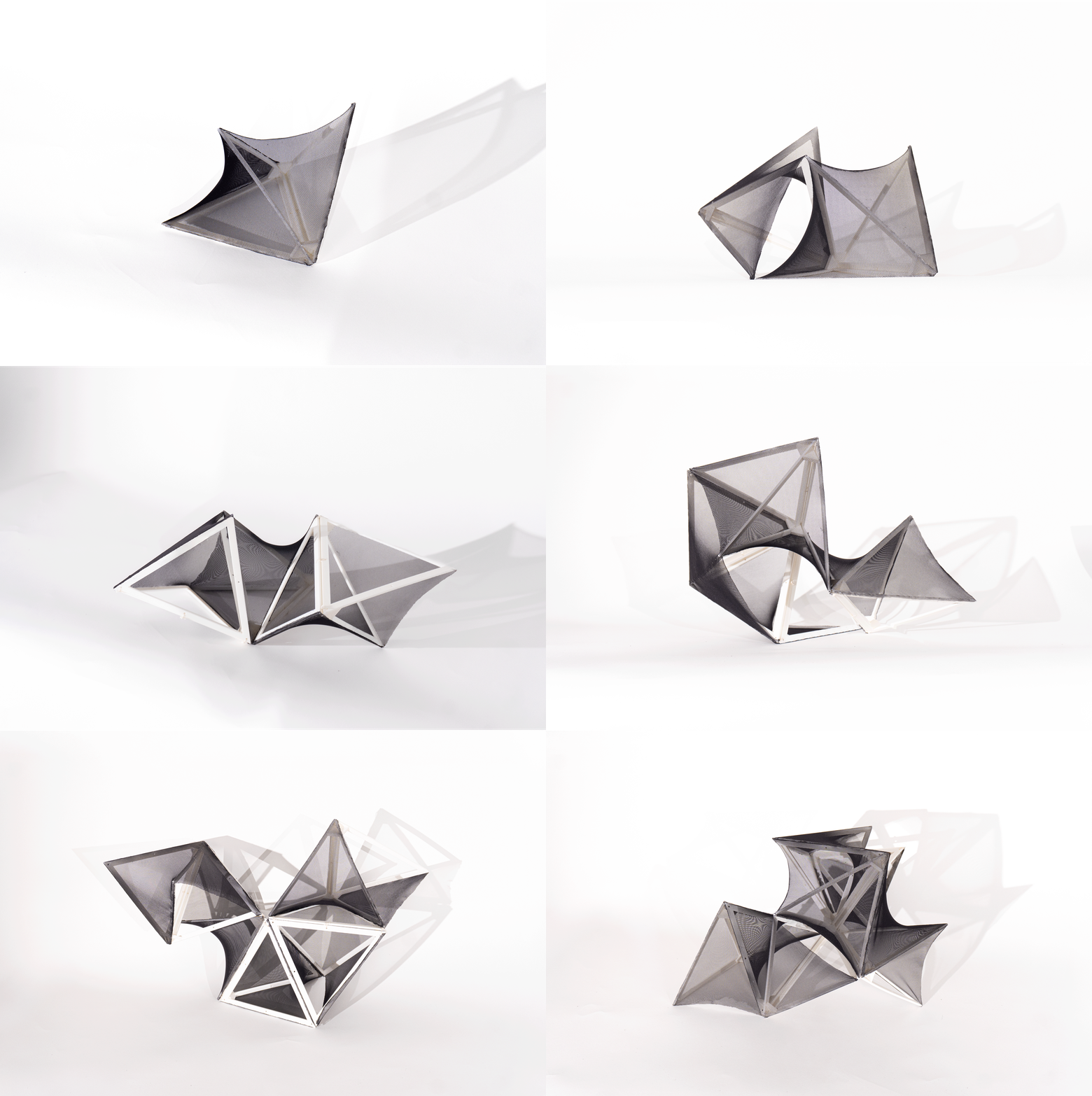
In this project, a modular membrane system is developed as a tension-based form-finding structure that explores how simple triangular units can generate complex spatial and architectural forms. Building on the previous hanging model assignment, which used a mesh grid of triangles connected edge-to-edge by string, this project continues the logic of triangular connection while transforming the role of the triangle itself. Instead of acting as the surface of the form, the laser-cut triangles operate as rigid frames that hold a stretchable membrane, allowing smooth curved surfaces to emerge through tension. Each unit is made from three triangular frames tied together along a shared edge, with fabric stretched between the outer edges to produce both a triangular enclosure and a hyperbolic paraboloid surface. Through this system, form is not fully predetermined but develops through the interaction of frame, membrane, tension, and connection. Across a progression of six iterations, the aggregation of these units moves from a single simple module to a more complex three-dimensional field, where repeated membranes create layered surfaces, varying enclosure, and spatial depth. The resulting configurations suggest lightweight canopies, enclosures, or multi-layered roof forms, demonstrating how a repeated triangular system can evolve into an architectural structure with both geometric clarity and fluid spatial qualities.